
TL;DR: CISA Cyber Essentials is a free, voluntary framework that helps small business owners build a basic cybersecurity program. It isn’t a law, but the controls it points to (multifactor authentication, fast patching, and tested backups) are now what cyber insurers and larger partners expect. In 2026, CISA refreshed its companion Cybersecurity Performance Goals to version 2.0. Here’s what that means and where to start.
Most small business owners think they’re covered. You have antivirus, you back up your files, and you feel ready. CISA Cyber Essentials exists for the moment that belief breaks, when one stolen password becomes a ransomware attack and you learn that basic tools were never enough.
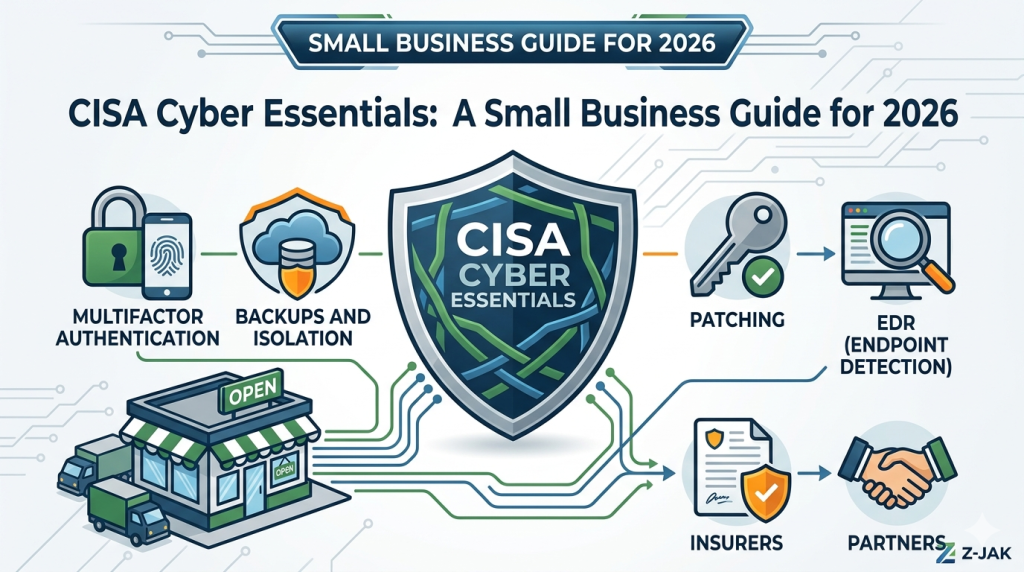
Here’s where people get confused. Some owners hear “Cyber Essentials” and assume there’s a brand new rulebook they’re breaking. The program is voluntary. But the steps it recommends have quietly become the baseline that insurers, banks, and large customers expect.
This guide covers what CISA Cyber Essentials asks of you, what actually changed in 2026, and the short list of controls that protect your business and keep your insurance valid.
What Is CISA Cyber Essentials, and Does My Business Have to Follow It?
CISA Cyber Essentials is a free guide from the federal Cybersecurity and Infrastructure Security Agency that helps small business leaders build what it calls a “Culture of Cyber Readiness.” It’s voluntary, not a legal requirement. It organizes basic security into six essential elements any owner can understand and act on.
The agency built CISA’s Cyber Essentials guide for leaders of small businesses and local government offices that don’t have a security team. The six elements cover you (the leader), your staff, your systems, your surroundings, your data, and your response to an incident.
Nobody audits you, and there’s no badge. CISA lined it up with the NIST Cybersecurity Framework, so the steps you take now prepare you for stricter standards later.
So why does it feel like a requirement? Because customers, banks, and insurers increasingly ask whether you follow a recognized baseline. Saying yes is far easier when you already have one in place.
The Real 2026 Update: CISA’s Cybersecurity Performance Goals 2.0
If you came looking for “new Cyber Essentials requirements,” here’s the honest answer. The Cyber Essentials guide itself hasn’t changed much since it launched. The real update for 2026 is a companion framework called the Cybersecurity Performance Goals, or CPGs.
In early 2026, CISA released version 2.0 of these goals. What changed is who they’re for. The CPGs started as guidance for utilities and critical infrastructure. Now CISA points to them as the practical starting baseline for small and mid-sized businesses too, with a new self-assessment checklist arriving in early 2026.
The goals are short and high impact. They focus on actions that block the most common attacks: multifactor authentication, strong passwords, fast patching, and a plan for when something goes wrong. If Cyber Essentials is the “why,” the CPGs are the “what to do first.”
Which Cybersecurity Controls Should a Small Business Set Up First?
Start with six controls: enable multifactor authentication everywhere, replace basic antivirus with endpoint detection and response, keep backups isolated and tested, patch high-risk vulnerabilities quickly, train your staff to spot phishing, and write a simple incident response plan. These block the attacks that hit small businesses the most.
Multifactor authentication, or MFA, asks for a second step beyond your password, like a code from an app. It’s the most effective habit on this list. Turn it on for email, your VPN, remote desktop, and every admin account, not just one.
Endpoint detection and response, or EDR, watches each device for suspicious behavior and reacts in real time, unlike basic antivirus that only blocks threats it already knows. CISA’s own guidance for small businesses stresses making MFA mandatory through technical controls, not trusting people to opt in.
Backups are your last line of defense against ransomware. Keep at least one copy offline and test that you can restore it. Our data backup and recovery team builds this so a bad day doesn’t become a closed business.
Patch fast, because most break-ins use a known flaw that an update already fixed. And since people click before they think, regular security awareness training turns your staff into a first line of defense instead of a weak point.
Why Do These Basics Suddenly Matter for Cyber Insurance?
Because in 2026, cyber insurers require proof of these exact controls before they’ll issue or renew a policy. If you check “yes” on the application but a control isn’t really in place, the carrier can deny your claim or void your coverage after a breach.
Underwriting has changed. Insurers paid out too many ransomware claims, so applications now read like an IT audit: Is MFA on your email? Do you run EDR? Are your backups isolated? Is your team trained?
The trap is partial credit. You turn on MFA for Office 365, assume it’s done, and check the box, but your VPN and admin accounts have none. After a breach, that gap can be treated as a misrepresentation, and your claim gets disputed.
The stakes are real. The FBI’s Internet Crime Complaint Center has tracked more than 50 billion dollars in reported business email compromise losses, and industry reports put the average small business ransomware incident well above 250,000 dollars once you add downtime and recovery. Strong email and phishing protection closes one of the most common doors attackers use.
How to Put CISA Cyber Essentials Into Practice Without an IT Department
You don’t need to hire a security team to get started. You need a clear order of steps and someone accountable for each one.
Begin by naming an owner: one person responsible for security, even if it’s you. Then write down what you have, since you can’t protect what you haven’t listed: every device, every cloud app, every account.
Next, close the obvious gaps in order. Turn on MFA across all systems. Set a rule that high-risk updates get installed quickly, not “eventually.” Review who has access every quarter, and remove anyone who left or changed roles.
Finally, write a one-page incident response plan that answers a simple question: who do we call, and what do we do first, if something goes wrong? You don’t want to sort that out during an attack.
Many owners hand this work to a partner. Our managed IT services handle the rollout and the documentation, and our cybersecurity consulting aligns your controls with frameworks like CISA’s and the standards your insurer cares about.
Where Louisville Businesses Should Go From Here
CISA Cyber Essentials gives you a free, trusted starting point, and the 2026 update raised the bar on what counts as a baseline. The framework is voluntary, but the controls behind it are now expected by insurers and customers. The same steps that satisfy CISA also keep your cyber insurance valid, and none of it requires a big budget to begin.
The hard part isn’t understanding the steps. It’s finding the time to do them right and prove they’re working. If you’d like a partner to map your gaps and build a baseline that holds up, reach out to our team and we’ll show you exactly where to start.
Frequently Asked Questions
Is CISA Cyber Essentials mandatory for small businesses?
No. CISA Cyber Essentials is voluntary guidance, not a law. There’s no audit and no certificate. But the controls it recommends have become the baseline insurers, banks, and larger customers expect, so it often feels less optional than it technically is.
What is the difference between CISA Cyber Essentials and the Cybersecurity Performance Goals?
Cyber Essentials is the broad framework for building a culture of security across six elements. The Cybersecurity Performance Goals, updated to version 2.0 in 2026, are a shorter list of specific, high-impact actions. Think of Cyber Essentials as the mindset and the CPGs as the to-do list.
Does following CISA Cyber Essentials help with cyber insurance approval?
Yes. The controls CISA recommends (MFA, EDR, tested backups, patching, and staff training) are the same ones insurers now require. Putting them in place and documenting them improves your odds of approval, can lower premiums, and guards against a denied claim over a control you claimed but didn’t have.
What are the six essential elements of CISA Cyber Essentials?
The six elements are your role as the leader, your staff, your systems, your surroundings (your networks and devices), your data, and your response to incidents. Each comes with practical actions, so you can improve one area at a time instead of all at once.
How much does it cost to implement CISA Cyber Essentials?
The guidance itself is free. Your real cost is the tools and time to put the controls in place, such as MFA, EDR, and backups. Many are affordable for small businesses, and a managed IT provider can bundle them so spending stays predictable.
Ready to Build Your Baseline?
You don’t have to sort through federal frameworks alone. Our team can assess where you stand today, close the gaps that matter most, and document everything so you’re ready for your next insurance renewal. Schedule a quick call with Z-JAK and we’ll turn this checklist into a plan for your business.